Research Project
Development of Non-destructive Methods for Predicting Nutritional Content of Black Soldier Fly Larvae
Research Overview
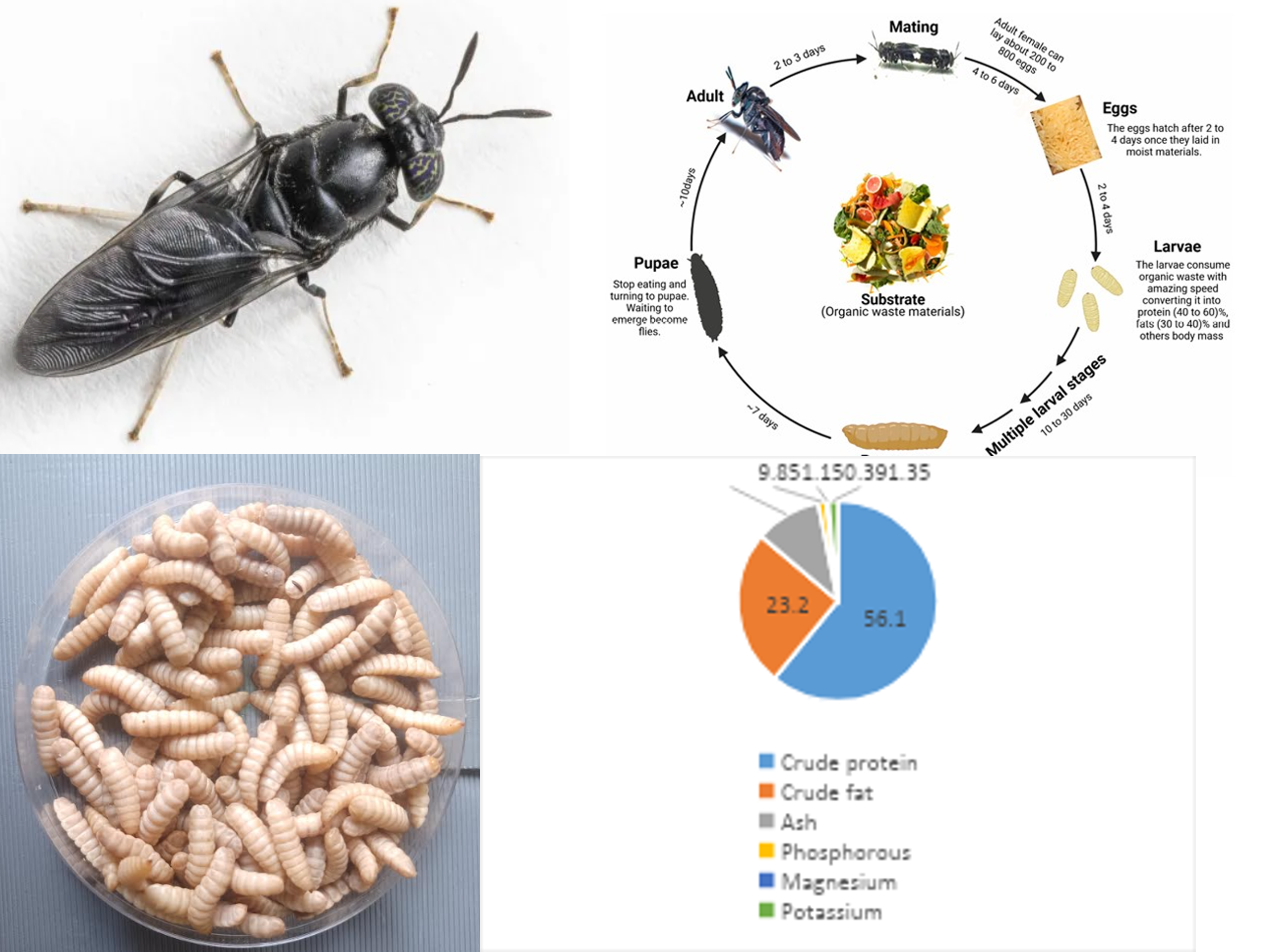
The Black Soldier Fly larvae (BSFL: Hermetia illucens) have gained attention as a sustainable alternative protein and fat source for animal feeds, due to their high protein and fat content. This work proposes using emerging technologies such as Hyperspectral Imaging, Spectroscopy, and Chemometric methods to predict protein and fat content in BSF. Accurate determination of protein and fat is critical for optimizing production and ensuring quality. Conventional chemical analysis methods are precise but often destructive, time-consuming, and unsuitable for large-scale analysis. This study develops non-destructive, high-throughput methods for predicting the nutritional content of BSFL using spectral imaging, spectroscopy and machine learning. Different spectral sensors and cameras capture a broad range of spectral information from BSFL. This enables detailed analysis of chemical composition without destroying physical samples and supports a more sustainable, efficient, and environmentally friendly nutritional composition analysis. Spectral signatures extracted from BSFL hyperspectral images will undergo preprocessing to enhance signal quality and reduce noise. These processed spectra will then be used to derive informative spectral features for subsequent analysis. These features will be combined with respective ground truth data to train and validate a machine learning models using model performance metric parameters. Results will demonstrate that the developed models accurately predict BSFL protein and fat content. This approach offers a rapid, non-destructive alternative to traditional chemical analyses, making it suitable for real-time monitoring and quality control in BSFL production. The study shows the potential of integrating hyperspectral imaging and machine learning to advance precision nutrition analysis in the insect protein industry.
Core Objectives
Develop spectroscopy and spectral imaging-based method for determination of the BSFL protein and fat content.
Develop machine learning models to enable prediction of nutritional content and composition of BSF larvae using spectral and image data.
Evaluate model performance and accuracy in predicting the protein and fat content.
Implement non-destructive techniques for nutritional composition determination systems developed in BSFL production systems.
Methodology
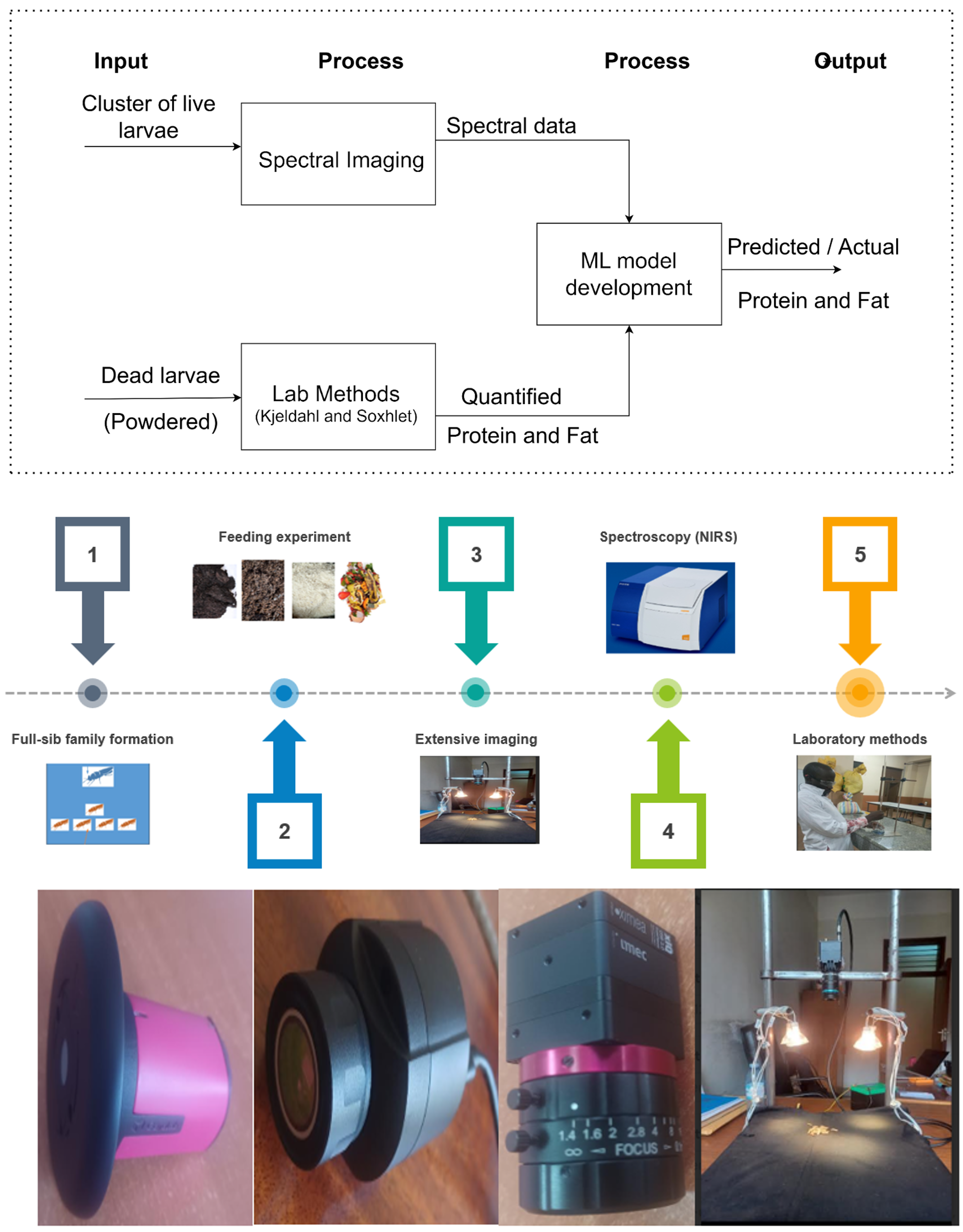
The methodology involves selection and preparation of BSFL samples from different substrates such as maize bran, wheat, food waste, soya and many others. The non-destructive techniques employed, such as Extensive imaging systems using spectral cameras (Snapshot hyperspectral camera) and sensors (MicroNIR and Goyalab), then Lab determination methods such as Kjeldahl and Solvent extraction method employed for ground truth data. Finally predictive models established using both the spectral data and the ground truth data.
Outcome
By overcoming the limitations of slow, destructive, and costly analytical techniques, this research will deliver a game-changing, non‑destructive, and high‑throughput approach for predicting the nutritional composition of BSFL. The outcomes have the capacity to reshape practices across the insect farming sector, the feed and food industries, and the wider field of sensing technologies. The impact will be realized through the following contributions:
Introduction of a rapid, non‑destructive analytical method capable of replacing conventional laboratory assays, allowing real‑time nutritional assessment without sample destruction.
Strengthening quality and safety assurance in the feed and food industries, where fast and accurate nutritional profiling is essential for compliance, formulation, and product consistency.
Facilitating sustainable protein production by providing efficient tools for monitoring and optimizing the nutritional value of insects, supporting the worldwide shift toward alternative protein sources.
Cutting operational costs, hazards, and bottlenecks in insect farming through automation‑ready, high‑throughput sensing that improves productivity and decision-making.
Partners and Collaborators










Published Article
Frank Ssemakula, Sarah Nawoya, Catherine Nkirote Kunyanga, Roseline Akol, Dorothy Nakimbugwe, Rawlynce Cheruiyot Bett, Henrik Karstoft, Kim Bjerge, Andrew Katumba, Cosmas Mwikirize, and Grum Gebreyesus. Emerging technologies for fast determination of nutritional quality and safety of insects for food and feed: A review.
DOI https://doi.org/10.1016/j.compag.2025Research Team

Frank Ssemakula

Dr. Andrew Katumba

Dr. Roseline Akol

Prof. Dorothy Nakimbugwe