Title
Real-time Tele- consultation for Cervical Cancer Screening Using a Machine Learning-enabled Mobile App
Team
Hanifa Nabuuma, Andrew Katumba, Ben Wycliff Mugalu, Mark Phillip Matovic
Category
health
Description
Cervical cancer in particular is the fourth most common cancer in women, and the seventh overall, responsible for 569,847 deaths globally
(World Health Organization 2018). Over 85% of the global cervical cancer burden occurs in LMICs. In Uganda, cervical cancer is the
commonest cancer in women and the incidence is increasing (Wabinga et al. 2014). Effective identification and treatment of precancerous
cervical lesions or early stage cervical cancer is the most important intervention in the fight against cervical cancer. Women are screened
by visual inspection with acetic acid (VIA) and those with lesions treated before the lesions become cancerous. HIV positive women should
be screened annually while those who are negative should be screened every 3 years (Nakisige, Schwartz, and Ndira 2017). Lack of
awareness among the healthcare workers, at frontline facilities, who lack oncology knowledge, is another challenge. Another challenge is
the lack of means to notify patients when they are due for (re)screening.
Wabinga, Henry R., Sarah Nambooze, Phoebe Mary Amulen, Catherine Okello, Louise Mbus, and Donald Maxwell Parkin. 2014. “Trends
in the Incidence of Cancer in Kampala, Uganda 1991-2010.” International Journal of Cancer 135 (2): 432–39. doi:10.1002/ijc.28661.
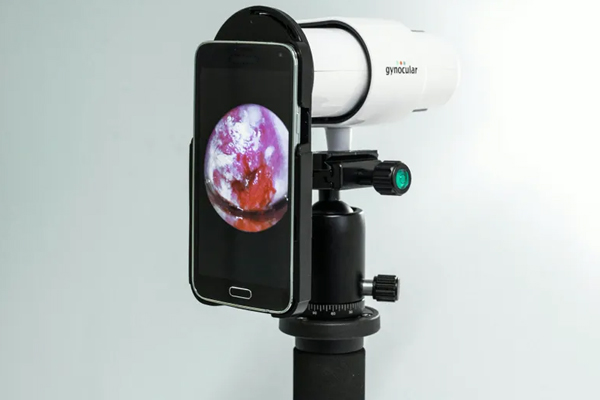
To promote early detection in rural areas, Uganda Cancer Institute (UCI) implemented set up a mobile colposcopy at its satellite clinic in
Mayuge where health workers use it to capture cervical images and transmit them to UCI for experienced gynecologists to examine them
and advise the health workers on more complex cases. To make this consultation real-time, we developed a mobile app through which the
health workers upload the images which the gynecologists can view immediately and enter their impression which the health worker
can also view immediately. The mobile app is accessible on any Android smartphone.
The app has machine learning (ML) capabilities for classifying the images taken by the mobile colposcope. The images are classified as
classified as “positive”, “negative” and also indicate where lesions are. The ML classifications coupled with VIA screening help to improve the accuracy of the screening process. If gynecologists are unavailable, the ML capability can assist the health worker in their
decision. Finally, if the patient needs re-screening, the app will be able to send them a text message reminder for their appointment.
Project Images